Escoffier.   Georges Auguste     - Two Escoffier menus.
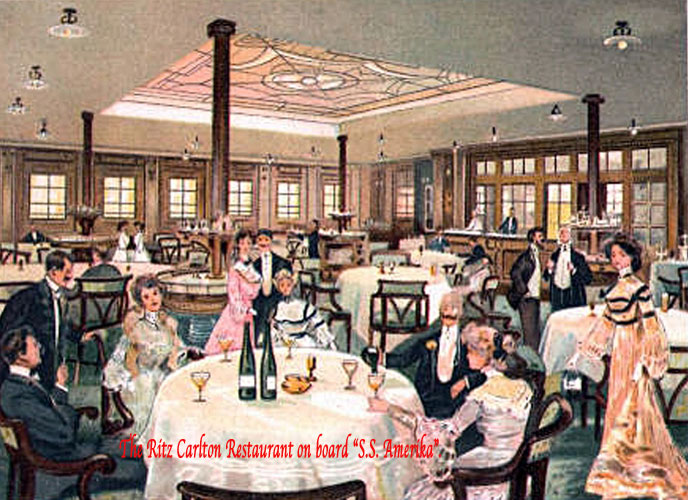
Ritz Carlton Restaurants on board the Hamburg Amerika Line ships.
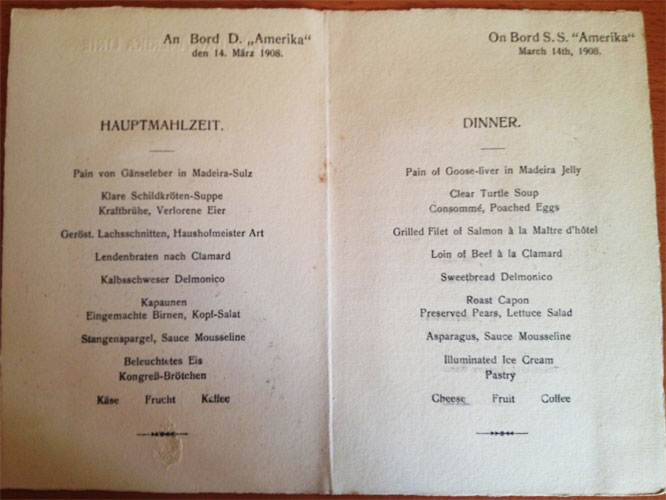
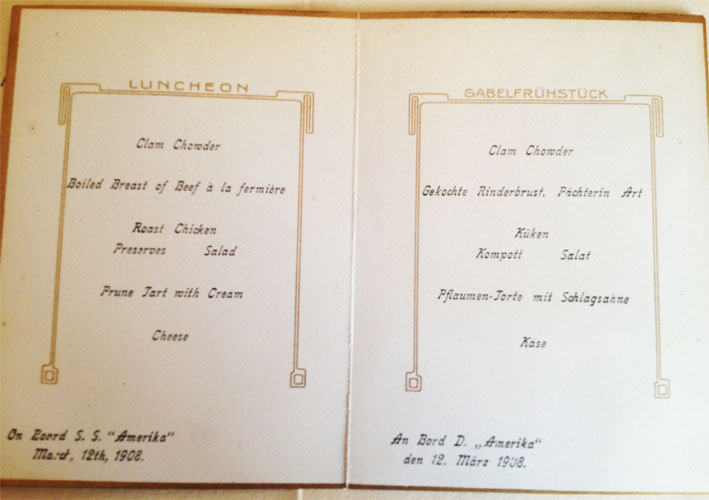
A Lunch and Dinner menu from the S.S. Amerika passenger liner, March 1908.
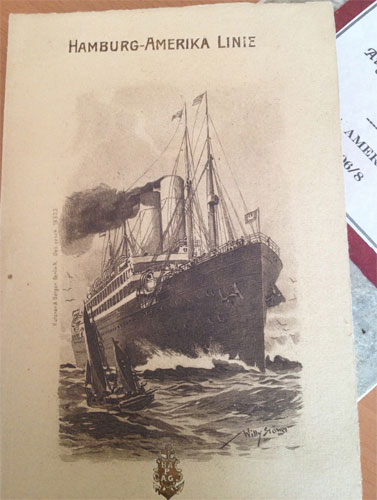
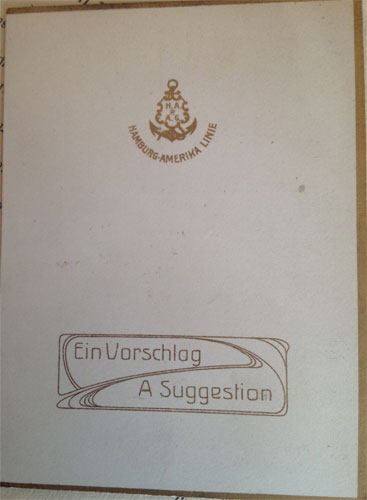
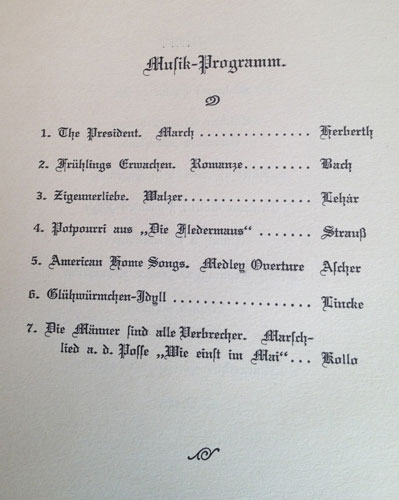
Menu 1. Dinner dated March 14th 1908 - 177x117 mm. A folded card with a very good drawing of the SS Amerika on the front cover. Inside a 12 course dinner in English and German with French and a few US dishes. On the back cover is the music programme with a lovely drawing of a violinist. Clean and handsome. Menu 2. Lunch dated March 12th 1908 - 130x90 mm. . A folded card with a header titled ‘A Suggestion' on the front cover. Inside a plain 6 course lunch in English and German. On the back cover are a couple of glue strips that suggest this menu was pasted into a folder at some time. All text and menu borders in gilt. The guttering has been strengthened but still a clean and handsome item. Overall in very good condition and housed in a handsome cardboard folder covered in grey marbled paper with a label on the front cover. A rare item of Escoffier ephemera.
- The Hamburg Amerika Liner company requested Auguste Escoffier and Cesar Ritz’s services for the planning and inauguration of the Kitchens and Restaurants on the brand new liners "S.S. Amerika" and the 'S.S. Kaiserin Auguste Victoria. Both of these ships were built side by side at the Harland Wolff shipyards in Belfast. 'Amerika' was launched first on April 20th 1905, According to the Morton Allan Directory of European Passenger Steamship Arrivals (Baltimore: 1987), the “S.S. Amerika" sailed between Hamburg and New York from 1905-1913. For the year 1914 it sailed between Hamburg and Boston; the Amerika's last U.S. arrivals were to Boston on 19 June and 24 July 1914. In 1912, it was the first ship to warn Titanic of icebergs. The kitchens and dining rooms of the liners S.S. Amerika and S.S. Kaiserin Auguste Victoria opened with the very original a la carte restaurants. The service on board all of those liners was called the “The Ritz Carlton Restaurants”. There had never been an a’la Cartre restaurant of any kind on a ship before. Adding the names of Escoffier and Ritz to this novel enterprise and the interest, support and demand completely filled the dining rooms every day. The new restaurants became stunning successes. They even had to significantly expand the kitchen of the 'S.S. Kaiserin Auguste Victoria' after the first voyage. Escoffier’s secondment from the Carlton Hotel to the Hamburg Amerika line was to last until 1915 and would further help to cement his reputation as the gastronomic Master craftsman of the age.
click on image to enlarge
Information

Ephemera category
ref number: 11214
Escoffier.   Georges Auguste     - A very rare item.
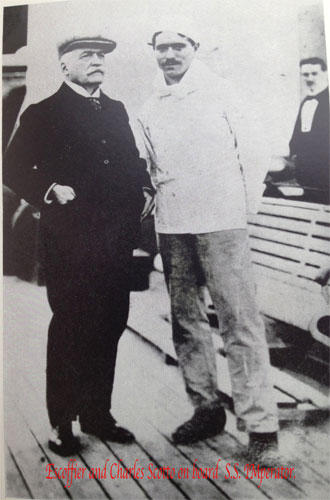
One of Escoffier and Charles Scotto's Menus, .
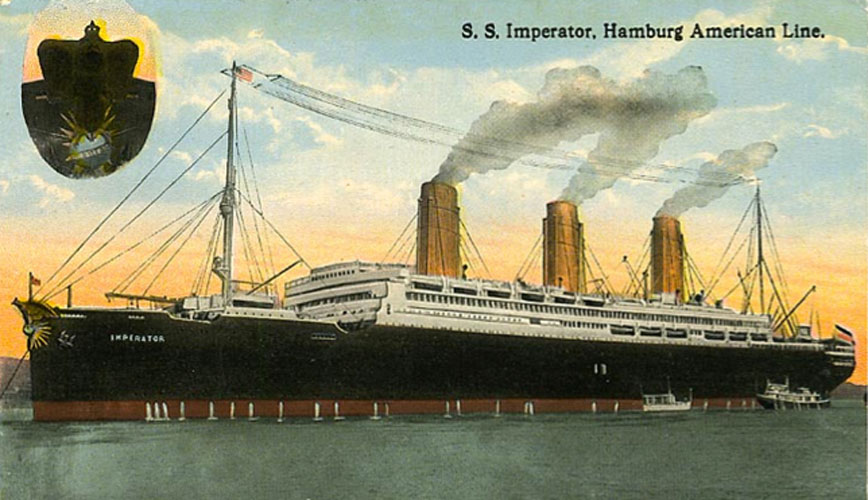
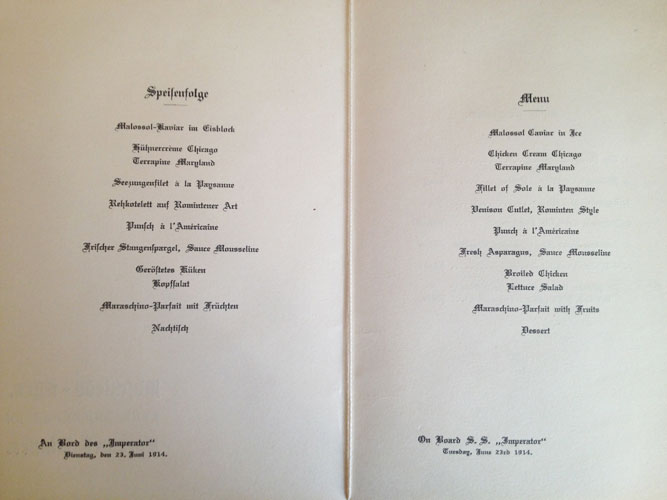
From the Hamburg Amerika liner S.S. Imperator. June 23rd 1914.
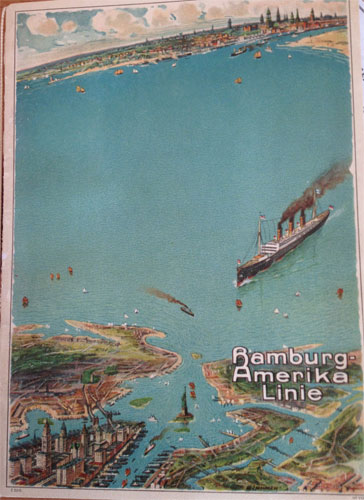
180x158 mm. 4 pages. The front cover of the menu is an unusual birds-eye view of New York Harbour with S.S. Imperator steaming towards the Statue of Liberty and skyline of N.Y. in a circle. Beautifully observed and painted. 1st page, A farwell Dinner. Nice big menu written in English and German with eleven courses of French and American dishes. On the verso of the 3rd page, a music programme. Overall in very good condition and housed in a handsome cardboard folder covered in crimson marbled paper with a label on the front cover. A rare item of Escoffier and Charles Scotto ephemera.
- In 1912 the Hamburg Amerika line again requested Escoffier’s services for the planning and inauguration of the kitchens on the brand new 53,000 ton liner, S.S. Imperator. Escoffier had previously planned and opened in 1905, the kitchens and dining rooms of the liners S.S. Amerika and S.S. Kaiserin Auguste Victoria. The new restaurants had been a stunning success. Those a'la carte restaurant services on board all of those liners were called the “The Ritz Carlton Restaurants”. On the Imperator, Escoffier brought his famous pupil, Charles Scotto to be the Head Chef. The official trial cruise was to have an illustrious passenger; Emperor William. On the 8th July 1912, the Emperor boarded and they weighed anchor immediately and set sail towards Heligoland. On the last day of the Emperor’s stay on board He had a conversation with Escoffier. He thanked him for taking responsibility for the cuisine and how delighted He had been at the level of comfort He had experienced on board. In August 1914, as World War I began, the S.S. Imperator was laid up at Hamburg and remained inactive for more than four years until 1918. This menu is a ‘Farewell Dinner’ dated June 23rd 1914. It is not inconceivable that it is a part of the overall farewells of many people associated with this great ship. It is also rare to be able to tie down a Charles Scotto menu. He was to become one of the leading Chefs of the early American Culinary associations and schools. Becoming as famous there as his Master. Ref: Herbodeau and Thalman’s fine autobiography of Escoffier’s life.

click on image to enlarge
Information

Ephemera category
ref number: 11213

Escoffier.   Georges Auguste     - Extremely rare.
Signed photograph.
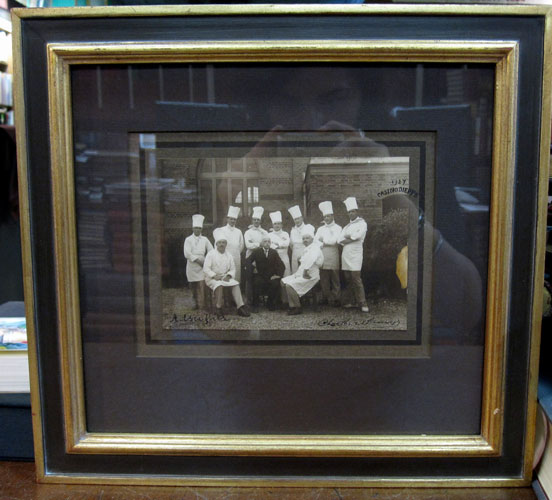
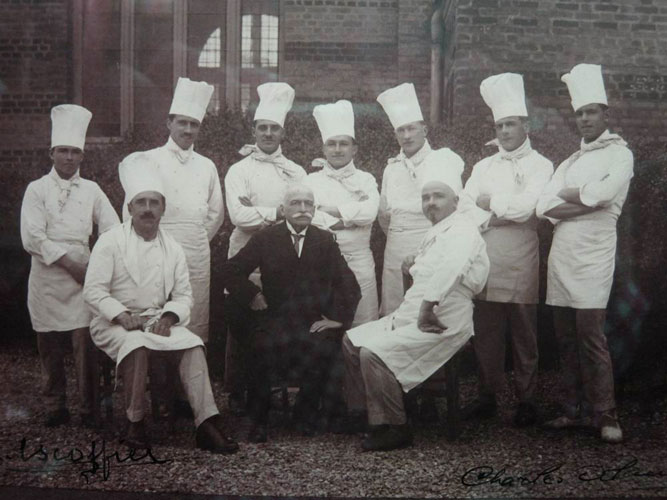
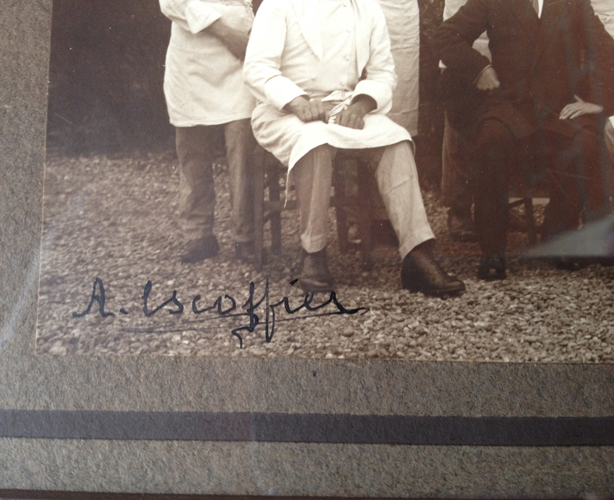
A group of nine chefs with George Auguste Escoffier, one of whom is also Escoffier's famed pupil - Charles Scotto.
Vintage sepia mounted photograph framed beautifully in a dark brown matte cardboard border and enclosed in a brown and gold frame, measuring 12”x13”. The photograph itself measures 6 ½” x 4 ½”.
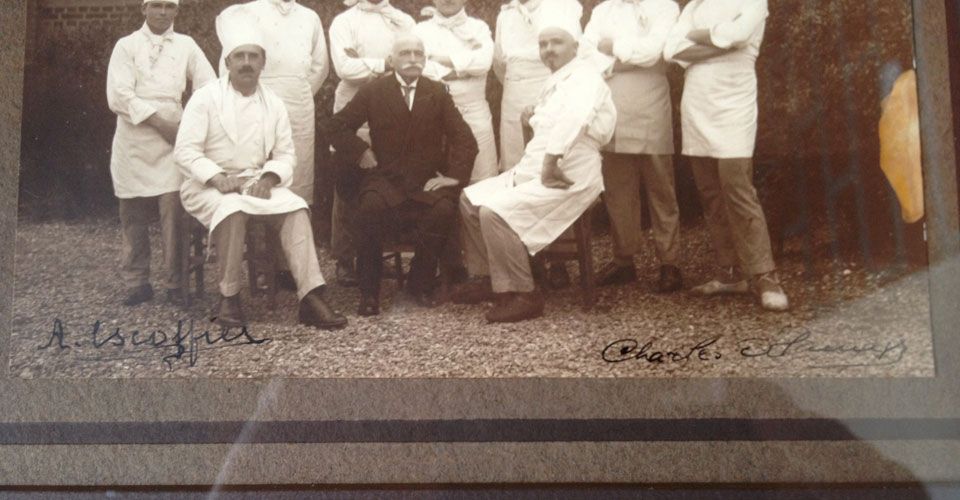
- This is a very rare signed photograph. It is a small brigade of chefs outside the legendary ‘Casino Dieppe’ France, circa - 1927. The uniqueness comes about by the inclusion within the group of the famous Chef, Auguste Escoffier seated in a dark suit, and also his famous pupil, apprentice and friend: Charles Scotto -- seated to Escoffier’s left. The signatures of Escoffier and Scotto are respectively on the bottom left and right of the picture. Charles Scotto was born 1887 in Monte Calro and in his youth became a close friend of Escoffier. At the turn of the century Scotto had been a commis chef in the brigade at the Savoy Hotel London where Escoffier was Maitre Chef de Cuisine. Scotto helped Escoffier all thro’ his professional life with planning and opening many new kitchens and restaurants such as the new Carlton Hotel in London’s Pall Mall and the extremely popular, new and innovative al'a Carte 'Ritz restaurants' on board the Hamburg-Amerika line, especially in the kitchens of S.S.Imperator (see item # 11213 on this site) where he was Escoffier's partner in this undertaking. He represented and helped Escoffier in the setting up and the opening of many of his other ventures over the years, including the famous 'Casino Dieppe, Normandy. In 1928, at the Sorbonne in Paris, The World Chefs' Association was formed and it is still in existence today. Scotto was the first president. He also opened other hotels including the famous Pierre Hotel in New York. For the opening Scotto invited Auguste Escoffier (described by Andre L. Simon in his obituary to Escoffier in the 'Wine & Food Society' Magazine as his last official act). In 1935 Escoffier passed away in Monte Carlo. In America ‘Les Amis d' Escoffier’ held their first memorial dinner at the Jensen Suite of the Waldorf with 53 friends of the famous chef attending a memorable feast. In 1936, approximately a year after the death of Georges Auguste Escoffier, members of the American Culinary Federation [ACF] in New York City invited hoteliers and leading citizens to join with the chefs to preserve the culinary traditions of the master. The then - ACF President Charles Scotto, well known as Escoffier's "beloved apprentice," and General Secretary Joseph Donon, hosted the premiere meeting of their new society for gourmets in the Waldorf-Astoria Hotel on March 30, 1936. Rules were established that forbade drunkenness. Only wine or aperitifs were served. Les Amis prohibited smoking at table, claiming that anyone who smoked between courses did not deserve the title of gourmet. Speech making was not allowed either. Ultimately, dining rules required silence during dinner so guests could focus on the dish at hand without distraction. Charles Scotto passed away in 1937 aged only 51, following kidney surgery. More than 1,000 of his admirers and colleagues attended the funeral. A solemn high mass was celebrated at the Church of Our Lady of Refuge, on Ocean and Foster Avenues in Brooklyn, His widow traveled with his remains to Monte Carlo where he was buried. While photographs of Escoffier are quite common, those of Scotto are scarce and signed images of both chefs together are rare in the extreme.

click on image to enlarge
Information

Ephemera category
ref number: 11187

Escoffier.   Georges Auguste     - One of Escoffier's menus.
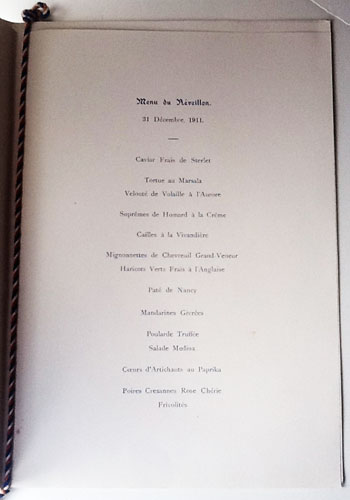
Menu du Reveillon, 31st December, 1911.
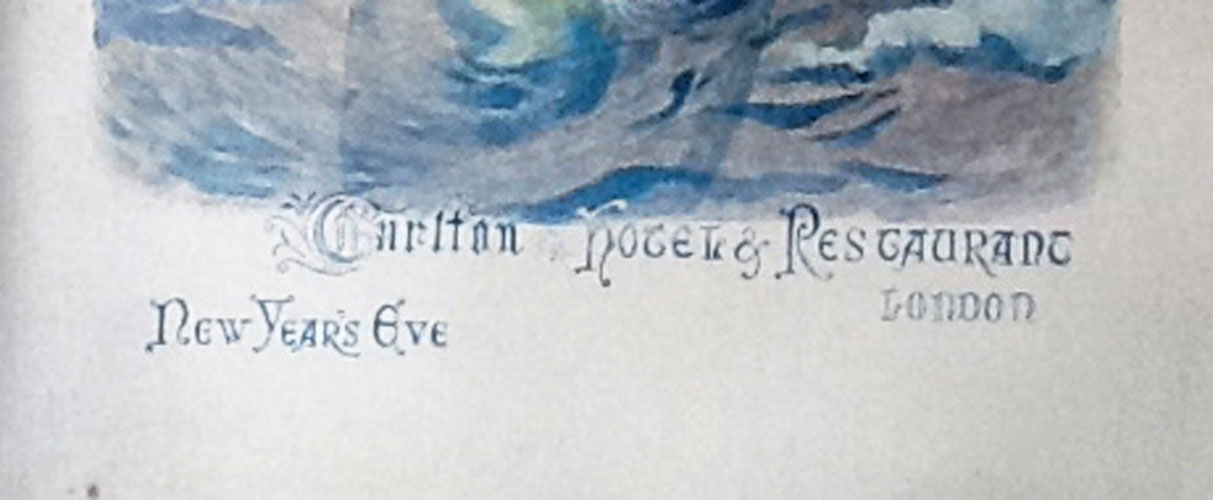
Carlton Hotel and Restaurant, London. New Years Eve.
286mm x 224mm. With a Great British Empire themed coloured picture on the front. It shows two men, one is a John Bull figure, the other, a Scotsman in a kilt, as well as two ladies representing Ireland and Wales. The dates on two boats prows showing 1911 and 1912. At the top, six little vignettes of famous scenes from countries under the crown. Cardboard cover with four pages. An impressive menu with fourteen items inside. Tied together with multi-coloured cord. A little foxing on the front but not affecting the overall image. A nice item of Escoffier ephemera in good quality paper(for the time).
- Considering this menu is 100 years old it has fared well. Looking thro' Escoffier's 'L'Aide-Memoire Culinaire' of 1910 one can see his dishes on offer for that New Year. His menus from his time at the Carlton Hotel from 1899 - 1919 are very scarce, but when found they give a sense of place and gastronomic history other chef's menus lack.

click on image to enlarge
Information

Ephemera category
ref number: 11182

Escoffier.   Georges Auguste     - 2 of Escoffier's Carlton Hotel menus.
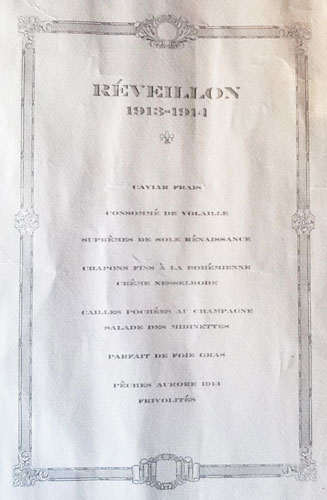
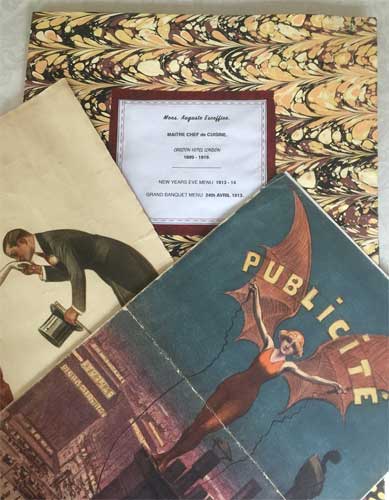
Menu Reveillon 1913 - 1914 and Menu Publicte 1913.
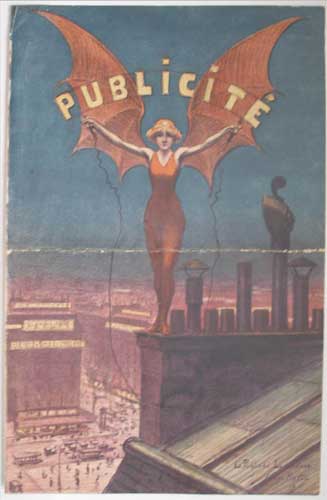
Two menus designed by Georges Redon, one with a large drawing titled "Hommages", and the other, a surreal painting entitled "Publicite".
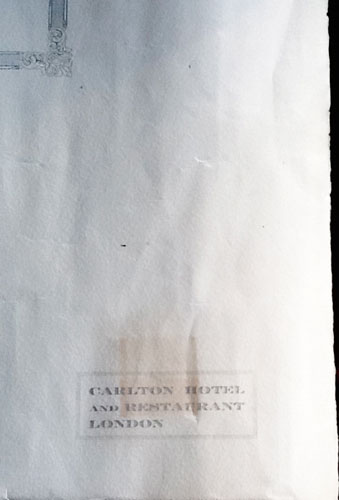
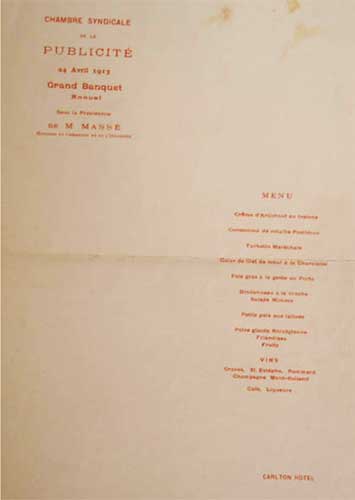
MENU 1. 413mm x 310mm. 4to. 4p. On the front is a lovely drawing of an Edwardian gentleman in tails and top hat kissing the hand of an equally elegant lady. Amusingly there are two dogs in the middle politely sniffing each other. Signed by the artist Georges Redon. At the bottom is a pink ribbon with a cardboard seal. On page three surrounded by an delicately etched Art Nouveau border is a New Years Eve menu (Reveillon) for 1913-14. On the bottom right hand corner is a little box with the words Carlton Hotel and Restaurant London. Large menu with the paper slightly age browned. MENU 2. 390 x 252mm. Dated 24th Avril 1913. This is an original 2 page folded cardboard menu titled "Publicite" for an Annual Grand Banquet at the Carlton Hotel with the front illustrated by Georges Redon.
 On the bottom right hand is printed : La Publicite Lumineuse, with Georges Redon signature dated '13'. It has been folded for storage, with a crease across the middle. An interesting and unusual menu. Overall two nice and very scarce items of Escoffier ephemera, housed in a cardboard folder covered in marbled paper with a red paper label.
- The First World War began on 28 July 1914 and lasted until 11 November 1918. More than 9 million combatants and 7 million civilians died as a result of the slaughter. This 1st MENU of 1913/14 was the last New Year's Eve when many friends seated at the same tables, and partaking of this special dinner of nine courses, would conceivably, never see each other again. With hindsight, the poignancy of this night of celebration, is one of the reasons that makes this Escoffier menu stand out. The 2nd MENU is an unusual Escoffier banquet menu of nine courses also designed and painted by Redon, and depicting a very surreal image of a winged woman on top of very high building about to take off on an adventure of mystery. Above the menu is a little explanation, informing that the occasion is publicity for a Chambre Syndicale. Each corporation or trade has it’s own Chambre syndicale, similar to trade unions taking care of the interests and members of their related associations. This Grand Annual Banquet was under the Chairmanship of Mons.Alfred Masse who was Minister of Trade, Industry, Posts and Telegraphs from March 22 to December 9, 1913 in the Government of Louis Barthou. Georges Redon (1869 – 1943) was a painter and lithographer. In the 1920s, he created and became famous for a series of charming images depicting little boys urinating. Because of today's concerns about paedophilia such images are no longer widely distributed, subsequently, it isn't easy to find any of Redon's famous "Pipi" works anymore. Many times Redon’s other pictures and artwork also conveyed a lot of humour, as is apparent in the first menu. He also created artwork for many food labels including biscuits and Chocolat Escoffier. Perhaps unsurprisingly, these two Carlton Hotel commissions hint at a strong professional collaboration between the two men. These very elegant, large menus from Escoffier's time at the Carlton (1899 - 1919), are fine collectors items. Definitely a cut above the norm, as the Artist and the Chef are both already famous, each within their own chosen fields of expertise.
click on image to enlarge
Information

Ephemera category
ref number: 11181

Escoffier.   Georges Auguste     - ‘Officier de la Legion d’honneur’.
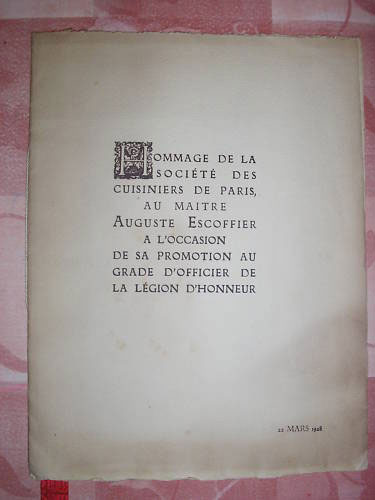
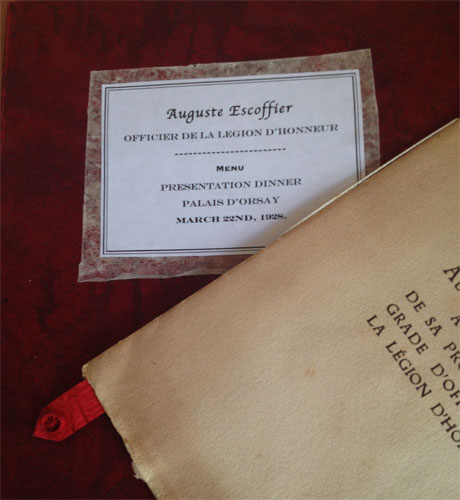
Menu of a banquet for Escoffier at the Palais d'Orsay.
In homage to Maitre Auguste Escoffier by the society of the 'Cuisiniers de Paris'. for the occasion of his promotion to ‘Officier de la Legion d’honneur’ on March 22nd, 1928 at the Orsay Palace.
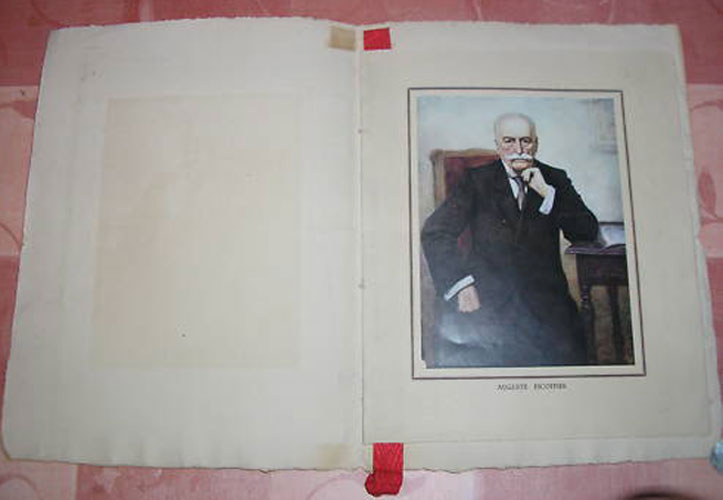
A four page menu within covers, with a print of a painted portrait of Escoffier (courtesy of the Foundation A. Escoffier at Villeneuve-Loubet), plus the wine list and menu. Very clean on white handmade paper with a red place ribbon and untrimmed edges, with the outside covers lightly age browned at the edges. A very handsome and unique item. The menu comprises: Creme de Volaille. Consomme Riche. Saumon de la Loire braise au Clicquot. accompagne: d'ecrevisses de l'Issole. Baron de Bebague. garni aux: primeurs de la Provence. Coq en Pate Palais d'Orsay. avec: une Salade Rosettte. Glace Legion d'Honneur. Roseaux pralines des bords du Loup. Corbeilles de Fruits. Friandises. The Wine list comprises: Five vintage Champagnes from 1919 and 1920. A Medoc et Graves. A Bitard Montrachet. A La Tache Monople 1918. The menu is housed in a handsome cardboard folder covered with red marbled paper and a label on the front cover.
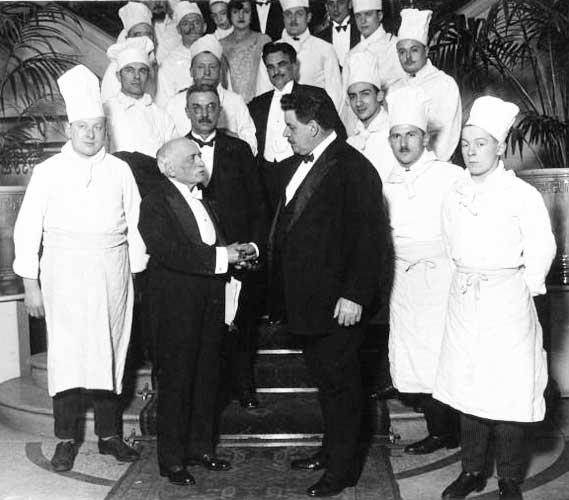
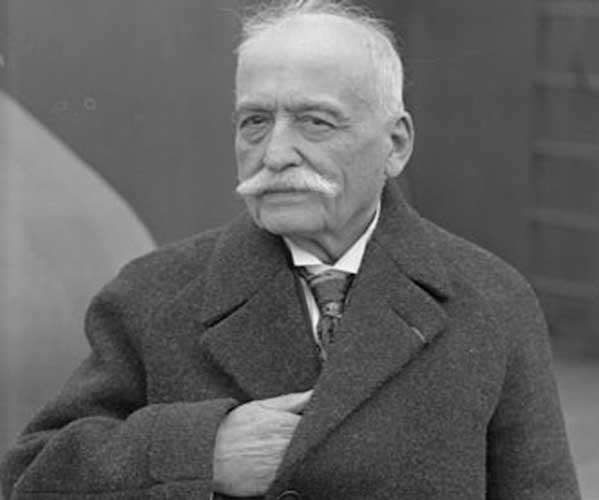
- From 1890 to 1920, Escoffier took over the management of the kitchens in many luxurious & prestigious hotels like The Savoy Hotel and The Carlton Hotel in London and Ritz Hotel in Paris. For almost thirty years, he served many of the most famous people of the time, creating for them unique dishes that became renowned, even to this day. After he left London in 1920, Escoffier returned to Monte Carlo and undertook a very active retirement. He never ceased writing culinary books until his death in 1935. Due to the gratitude and unforgettable memory of Escoffier, people, including his best friends and colleagues in London and Paris, created the Auguste Escoffier Foundation. This eponymous museum was established in 1959 in the house where he was born. Mon. Raymond Poincaré was a French conservative statesman who served as Prime Minister of France on five separate occasions and as President of France from 1913 to 1920. For Escoffier's work in promoting French cuisine, President Poincaré personally presented him with the cross of ‘The Légion d'honneur’ or ‘The Ordre national de la Légion d'honneur‘. This is a French order established by Napoleon Bonaparte, First Consul of the First Republic, on 19 May 1802. Escoffier in 1919, was the first chef to receive such an outstanding award. On March 22nd, 1928 he was promoted to the highest French honour as an ‘Officier de la Legion d’honneur’ and again became the first chef to have received this distinction. He was presented his medal by President Edouard Herriot at the Palais d'Orsay. The ceremony was followed at the Palais by, quote “a remarkable banquet" with Escoffier as the guest of honour. In the last b/w photograph below, Escoffier can be seen shaking President Herriot's hand at the Palais as he is leaving. He is also surrounded by the brigade of chefs that cooked the banquet. This extremely rare menu is from that memorable occasion.

click on image to enlarge
Information

Ephemera category
ref number: 11113

Escoffier.   Georges Auguste     - A signed handwritten letter
Addressed to 'Cher Monsieur Cadier'
And signed 'A Escoffier' on Carlton Hotel Stationary.
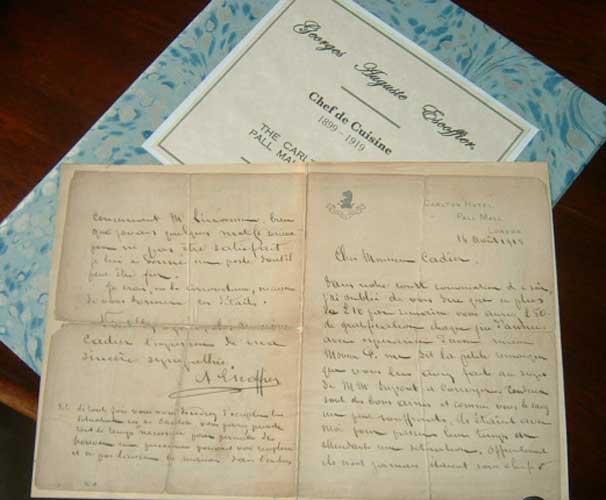
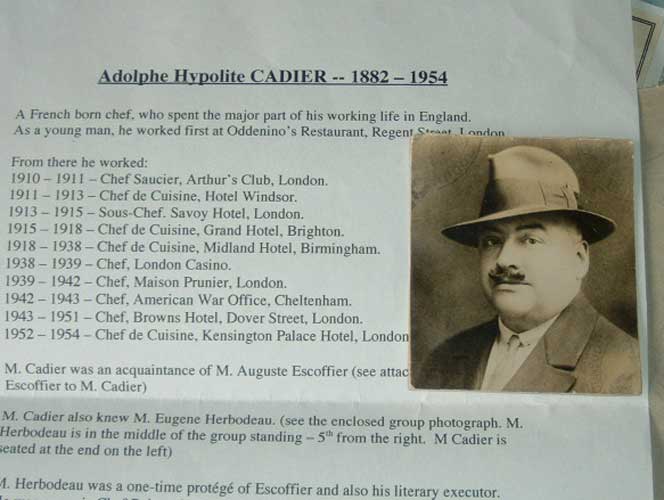
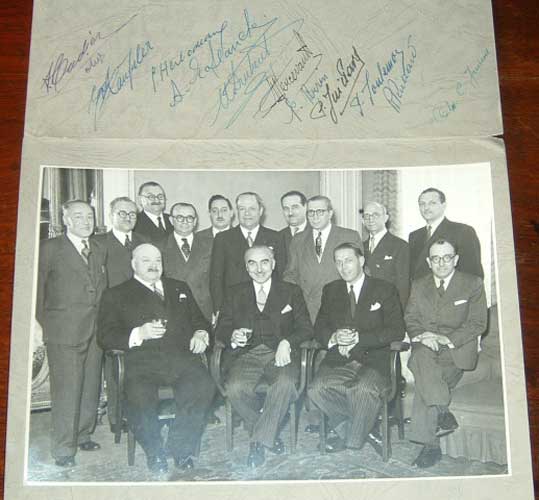
A 2 page manuscript letter, addressed to Mons. Cadier. On headed paper from the Carlton Hotel, Pall Mall. London. Dated 16 Avril 1918, with the Hotel Crest. The letter was folded in eight with creases, with one line partly obscured but still readable. The whole has been sometime mounted on same coloured card. Also enclosed is a black and white formal group photograph of many of the famous chefs of the day. All contemporaries of Escoffier. They are celebrating some occasion that honors Monsieur Cadier. All the chefs have signed the photograph. Among those present are M. Eugene Herbodeau, one-time protege of Escoffier and also his literary executor, also Auguste Laplanche, Maitre Chef de Cuisine at the Savoy Hotel for many years. Marcel A. Percevault, Maitre Chef de Cuisine of Claridges from 1933-54 is part of the group. Enclosed in a neat marbled cardboard folder with a large label on the front cover. Very rare items.
- In the letter, Escoffier writes in ink ---- [Dear M. Cadier, In our short conversation this evening, I forgot to tell you that over and above the 10 pounds per week you will have 50 pounds gratuity at the end of each year. M.P. informed me of the little remark you made to him on the subject of M.M. Dupont and Carriyer, both of them are good friends and, as you know, they are not particularly well (suffering a little). They have been with me to pass the time waiting for jobs. Officially they have never been sous chefs. With regard to M. Limassin, although I had certain serious reasons for not being satisfied I gave him a post he can be proud of. I believe that in view of the circumstances it is necessary to give you the details. Yours sincerely A Escoffier P.S. If at any time you wish to acquire a post at the Carlton you can take all the time you need to allow you to find someone to replace you thereby not leaving the firm in an embarrassing situation]. -- Adolphe Hypolite Cadier -- 1882 – 1954. A French born chef who spent the major part of his working life in England. On arrival he first worked at Oddenino’s Restaurant, Regent Street, London for a short time in 1910. Cadier also worked 1939-42, at the famous fish restaurant; La Maison Prunier, St James St. London. He is mentioned on page 254 of Madame Prunier's very good book -- La Maison, History of Pruniers. London. 1957. Escoffier was the Maitre Chef de Cuisine of the Carlton Hotel, London from 1899-1919. His concern and care for chefs who had worked under him is well documented. Escoffier himself, in the translation of his own recorded notes in his great grand-daughter-in-law, Laurence Escoffier's book, 'Memories of my Life', states; "During my career I was able to implant 2,000 French chefs all over the world" This letter is a fine indication of that care and tact, for which he was revered. Combined with the signed photograph of a large group of contemporary fellow professionals, very interesting items of pertinent Escoffier ephemera.

click on image to enlarge
Information

Ephemera category
ref number: 10988

Escoffier.   Georges Auguste     - In its original bottle with rare Escoffier ephemera.
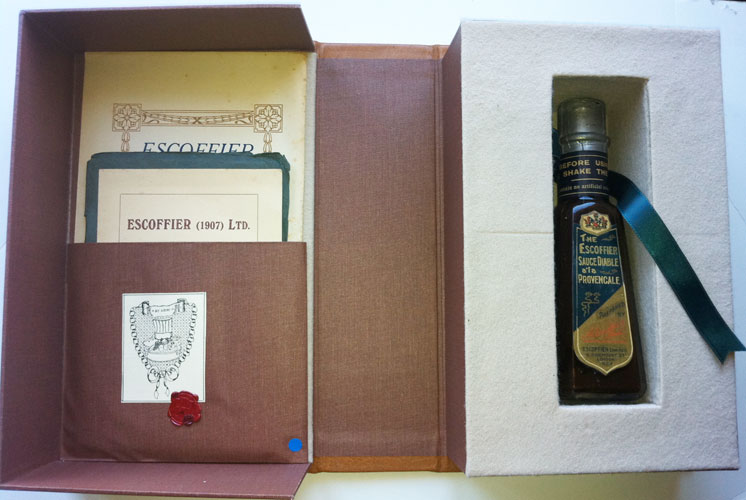
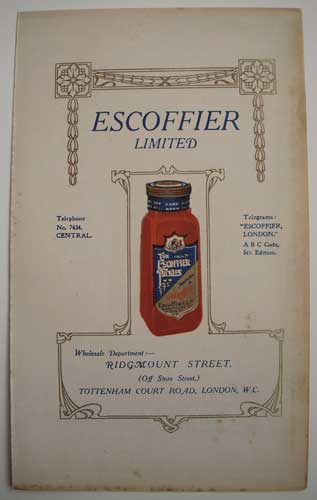
The Escoffier. Sauce Diable a'la Provencale
Four original items from Escoffier's company; Escoffier Ltd - 1903 and 1907.
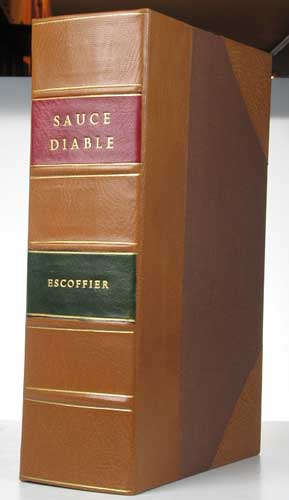
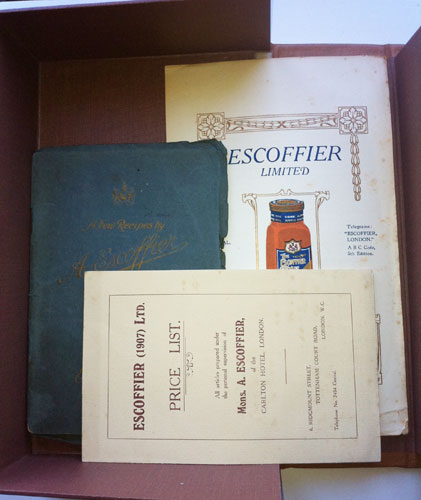
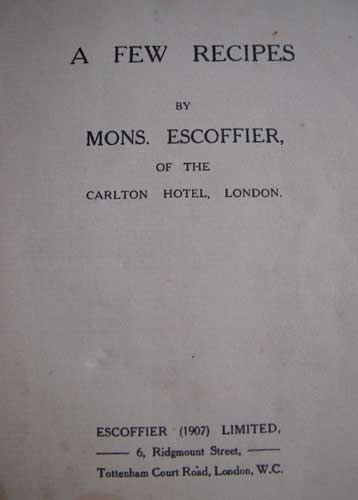
ITEM 1. An original bottle of "The Escoffier Sauce Diable a'la Provencale". The sauce is still liquid with trapped air bubbles. It has the original blind-stamped metal cap and labels, all in excellent condition. This is an original bottle with the Escoffier Ltd. Ridgemont address. Later bottles have 'Escoffier' embossed in the glass back and front, as well as other later London addresses on the front label. ITEM 2. A recipe booklet with the original blue covers slightly loose and a small strip missing from the front cover without loss to text.. It has Escoffier's name and the Carlton Hotel' coat of arms' embossed on the front cover. It is titled 'A Few Recipes' and has a title page. p 1 Introduction. p 4-38 Recipes. p 39-42 Cookery and Health tips. p 43 Advertisement for Escoffier Ltd. [1] p 45-46 Advertisement for 'A Guide to Modern Cookery'. [1] p 48-51 Index. [1] Slightly age-browned throughout with a small stain affecting first 2 pages but not the text. ITEM 3. A lovely beautifully produced four page 'Escoffier Ltd' promotional pamphlet and price list for all Escoffier Sauces, and we are also informed the Preparations can be obtained from all high-class Grocers and Stores. ITEM 4. This is a second four page promotional pamphlet and price list titled 'Escoffier (1907) Ltd', in nice clean condition, . As the first pamphlet is elaborately decorated with a coloured image of one of the products and the text in red and black, the second is obviously a cheaper and later price list aimed at cutting costs. Interestingly this later pamphlet informs that the Preparations are stocked by the majority of high-class grocers and stores throughout the United States. All housed in a specially made clam-shell box with half mid-tan calf and brown cloth boards. The spine with raised bands, gilt lines and one red and one green label with gilt lettering. The four items form a unique and rare look at the marketing for Escoffier's famous sauces.
- Georges Auguste Escoffier, who began his career as a chef at age 13 in 1859 and is credited as one of the creators of what is now considered classical French cooking and was far ahead of his time in surprising ways. In 1903, while Chef de Cuisine at the Carlton Hotel in London, he started a company, Escoffier Ltd., to sell his sauces. He was concerned about nutrition and the effects of the pace of modern life on dining; despite his devotion to the good life, he was not fat. He started experimenting with tinned vegetables, notably tomatoes. While still at the Savoy Hotel, London in 1898, he is credited, in their excellent biography of Escoffier by Eugene Herbodeau and Paul Thalamas, of first producing 2000 x 2 kilo tins of tomatoes in Saxon-les-Bains for the Savoy. The fame of the product grew so fast that the following year, the food manufacturer, La Maison Caressa of Nice produced 60.000 kilos under his direction. This was the precursor to his famous sauces being bottled and sold through Escoffier Ltd. In 1915 Escoffier Ltd was sold. (Sadly after 80 years of business deals and corporate takeovers, only a remnant of it lingers on in America in two products, Nabisco Sauces - Diable and Robert). Escoffier supported any effort that made cooking simpler, cleaner, better organized, more widely appreciated or easier for chefs and home cooks alike. Despite the foie gras and truffles, the elaborate garnishes and rich sauces listed in various editions of his cookery book 'Le Guide Culinaire', (1st ed. 1903) Escoffier's work was still a sharp departure from the culinary practices that existed before. Not only did he greatly simplify the recipes and methods of food presentation that had existed previously, but he also re-invented the very manner in which professional kitchens were organized. To speed up service, which was something diners even in his day demanded, he created the brigade system of key specialised departments with teams headed by Chefs de Parties, responsible for all the individual parts of the different dishes presented in all the menus; A'la Carte, Du Jour, Banqueting, Room service, Parties privees etc. He also invented the prix fixe menu. Another poorly recorded, but constant character trait of Escoffier, was the effort he expended to help improve the conditions under which chefs worked. "When I started, chefs had no status in society," he wrote in his memoirs. "That should not be the case because cooking is a science and an art, and the man who works with all his heart to satisfy people deserves to be recognized." The preface to his great classic, 'A Guide to Modern Cookery' - 1907, (the 1st English edition of 'Le Guide Culinaire' of 1903), is a revelation. From a chef’s point of view, the observations that Escoffier espoused then in 1903, and in subsequent editions, ring just as loud today. It is no wonder that modern chefs are re-finding Escoffier. It is also another indicator of his lasting genius and true impact over time. Pierre Escoffier, who was 26 when his grandfather died in 1935, helped create and head the Auguste Escoffier Foundation. The Escoffier Museum is now based near Nice in the village of Villeneuve-Loubet, in the house where Escoffier was born. This item belongs in such a museum. The original sauce in the bottle, the well produced 4 page 'Escoffier Ltd' promotional pamphlet, the other plainer but rarer price list, and the little recipe booklet by Escoffier, give a true insight into Escoffier’s marketing astuteness.

click on image to enlarge
Information

Ephemera category
ref number: 11051

Escoffier.   Georges Auguste     - A pertinant signed handwritten letter
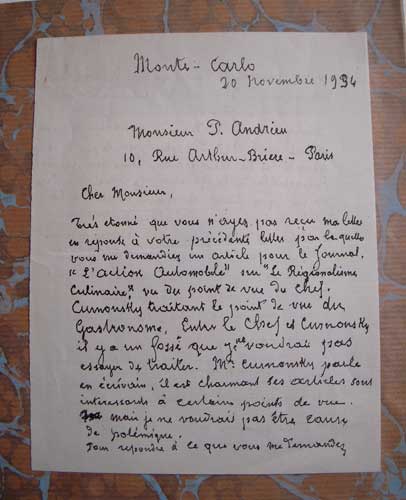
A letter to P. Andrieu, signed by Escoffier.
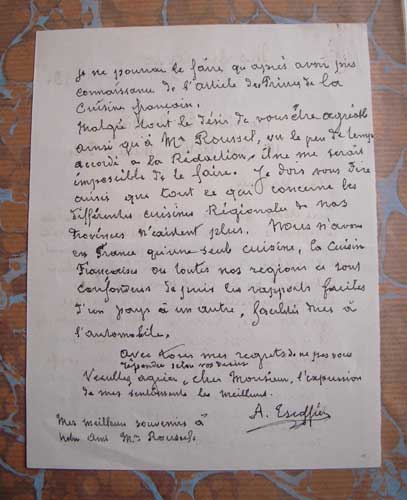
A two page letter written at his retirement home in Monte-Carlo, 20 November, 1934
Addressed to Monsieur P(ierre) Andrieu, --- Paris. The two pages are covered in Escoffier's handwriting. There is also a one page English translation of the letter. A very clean item. Enclosed in a neat marbled cardboard folder. With a label on the front cover. The letter is from the library of Pierre Orsi, the famous Lyon restuaranteur. A rare item.
- The letter is written one year before Escoffier's death. He writes in a rather shaky hand -- [Dear Sir, I am very surprised that you did not receive my letter which was in answer to yours, whereby you were asking me to write an article for the newspaper "L'action automobile". This article should have been about regional cuisine as seen from the point of view of the chef - Curnonsky treats it from the point of view of the gastronome. Between the chef and Curnonsky there is a wide gap that I do not wish to bridge. Mr Curnonsky speaks as a writer, he is charming and his articles are interesting in places but I have no desire to be the cause of any arguments. To answer your question, I could only do it after reading the article "les princes de la cuisine francaise". Despite all my desire to be agreeable to you and Mr Roussel, it will be impossible for me to do it. I must also tell you that the different regional cuisines do not exist anymore. Ever since all the "regions" have been merged by the advance of the automobile which created easier access from one country to another, we have now in France only one cuisine and that is French Cuisine. -- With deepest regret for not acceding to your wishes, Yours sincerely, A. Escoffier. -- My best wishes to Mr Roussel.] Pierre Andrieu was an author of many articles and books in the domain of wine and gastronomy. He was also a collaborator of Curnonsky's. Together they published in 1935 a book about the restaurants of France, titled 'Les Fines Gueules de France'. This letter pertains to the research for that book. Maurice Edmond Sailland (October 12, 1872, Angers, France – July 22, 1956, Paris), better known by his pen-name Curnonsky and dubbed the Prince of Gastronomy, was the most celebrated writer on gastronomy in France in the 20th century. He wrote or ghost-wrote over 65 books and enormous numbers of newspaper columns. He is often considered the inventor of gastronomic motor-tourism as popularized by Michelin, though he himself could not drive. The contents of the letter display an ironic point of interest. Escoffier, one year before his death is offering a glimpse of the changes he is seeing to his beloved French cuisine. Having re-organised, during his life time, the French kitchen so fundamentally from that of the Bel-Epoque era he is still only really interested in viewing the changes from the chef's point of view. It is obvious that even at the grand old age of eighty eight, he is still active and well informed.

click on image to enlarge
Information

Ephemera category
ref number: 10989

Escoffier.   Georges Auguste     - One of Escoffier's menus
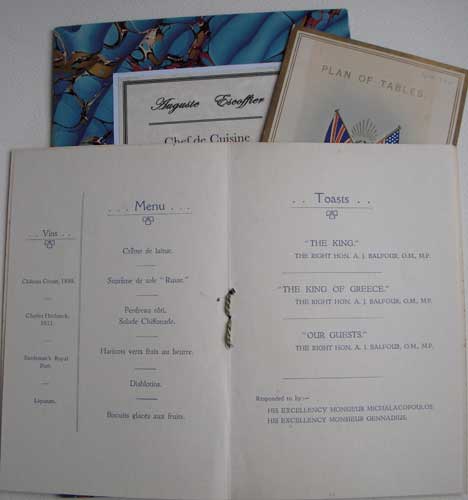
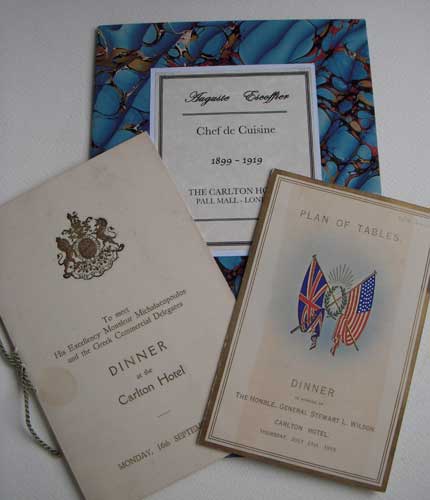
A menu and a table plan. Carlton Hotel. Pall Mall. London.
1.-- A Dinner Plan of Tables. Thursday. July 21st 1910. 2.-- Special Dinner Menu. Monday. September 16th. 1918.
1. -- This card is decorated by a double gilt border, front and back. On the front is an emblem of the American flag and the Union Jack. It is a four page ‘Plan of Tables’ for a Dinner in honour of General Stuart L. Wilson at the Carlton Hotel, Thursday, July 21st 1910. Seated at the ‘Red Table’ is Lieut. Sir Ernst H. Shackleton who was to set out 4 years later on ‘Endurance’ for his ill-fated attempt to reach Antarctica. It has taped marks on the back, indicating it has been sometime mounted in a book. 2. -- The menu is for a special Dinner at the Carlton Hotel on Monday 16th September 1918. Hosted by the Hon. A.J. Balfour MP for His Excellency Monsieur Michalacopoulos. The menu has an embossed gilt crest of the Royal Coat of Arms. Mons. Andre Michalacopoulos was the President for the Counsel of Ministers and Minister for Greek Affairs and A.J. Balfour was British Prime Minister from 1902 – 1905. It is a nice clean menu card with a 2 page insert tied by a ribbon. Both are housed in a nice cardboard, marbled folder with a label on the front cover. Rare Escoffier ephemera items.
- Escoffier was Maitre Chef de Cuisine at the Carlton Hotel from 1899-1919. These two items are his, from the Carlton Hotel kitchen banqueting department.

click on image to enlarge
Information

Ephemera category
ref number: 10993