Soyer.   Alexis Benoit     - A rare item of ephemera
An invitation card to the Dublin Soup Kitchen, signed by Soyer.
The cardboard invitation measures approx. 2"x3" It states: Soyer's Model Kitchen. For the Poor. Royal Barracks Esplanade. Admit (in manuscript [??] Jones) & Family. to the opening on Monday 5th April 1847. at half past 2 oClock. Within a simple decorated line border. Soyer's signature in blue ink at the bottom right hand corner.
Also enclosed are a two interesting articles copied from Irish newspapers, reporting on Soyers soup kitchens. Housed in a neat cardboard, marbled folder with a label on the front cover. An extremely rare item of Soyer ephemera.
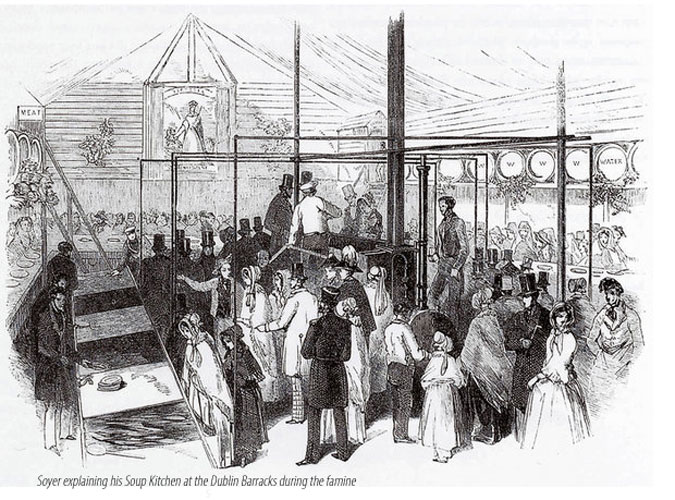
- George Augustus Sala, on meeting Soyer in the Hungerford Market recalls, -- He wore a kind of paletôt of light camlet cloth, with voluminous lapels and deep cuffs of lavender watered silk; very baggy trousers, with lavender stripes down the seams; very shiny boots and quite as glossy a hat; his attire being completed by tightly-fitting gloves, of the hue known in Paris as 'beurre frais' — that is to say, light yellow. All this you may think was odd enough; but an extraordinary oddity was added to his appearance by the circumstance that every article of his attire, save, I suppose, his gloves and boots, was cut on what dressmakers call a "bias," or as he himself, when I came to know him well, used to designate as "à la zoug-zoug". He must have been the terror of his tailor, his hatter, and his maker of cravats and under-linen; since he had, to all appearance, an unconquerable aversion from any garment which, when displayed on the human figure, exhibited either horizontal or perpendicular lines. His very visiting-cards, his cigar-case, and the handle of his cane took slightly oblique inclinations. This explains precisely why this invitation card on offer here is such an odd shape; it is "à la zoug-zoug". After the Soup Kitchen Act was introduced on January 25th 1847, Soyer was invited by the Government and funded by private subscriptions, to go to Ireland during the winter of 1847 while the Great Famine was raging. The Soup Kitchen was set up on the banks of the Liffey in front of the Royal Barracks, Dublin. The wooden dining room was forty foot long by thirty feet wide. Soyer's soup was cooked and served from a 300 gallon boiler that looked like a traditional steam engine. It also had an oven at the end to bake one hundred-weight of bread at a time. The soup bowls were stuck to the table and the spoons were chained to the bowls. One hundred ate their soup with relish (according to the newspapers) then left when a bell rang, followed by another hundred who came in for their soup and piece of bread. The food was also conveyed by vehicles to distant outlying areas, for infants, the sick and the aged. Newspapers report that on the day of opening the Kitchens to the poor, the Lord Lieutenant of Ireland and other notables were invited to view the Kitchens and Dining room. This invitation card is for one of those guests on that occasion. This Gala opening also caused some outrage in some newspapers, due to the undignified way the poor had to eat the soup in front of the privileged Guests. Never the less Soyer's kitchen was successful and his services were retained by the Relief Commissioners. In the midst of much publicity, Soyer opened a number of 'model' Kitchens in Dublin. Under the Act, soup kitchens were to be established in each of the electoral divisions. By July 1847, 1,850 Soup kitchens were in operation feeding over 3 million people throughout Ireland. Soyer, long gone by this time, received a beautiful snuff box amid great fanfare before his departure.

click on image to enlarge
Information

Ephemera category
ref number: 10991

SOYER.   ALEXIS BENOIT     Very rare; also with a very relevant letter signed by Soyer.
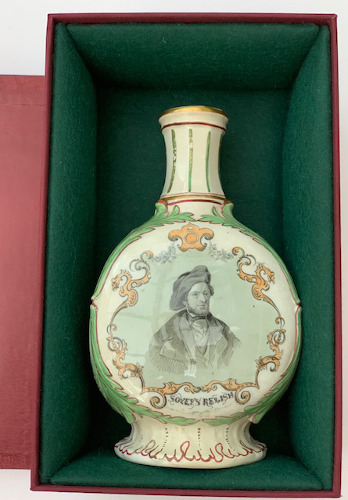
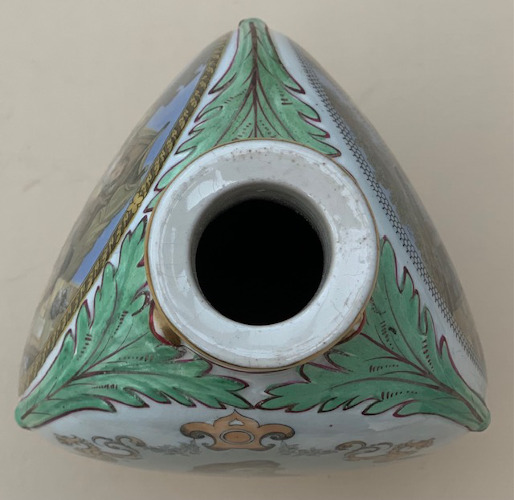
A FINELY DECORATED TRICORN PRATTWARE BOTTLE FOR 'SOYER'S RELISH'
Made by F.& R. Pratt & Co. A special limited edition Prattware bottle ordered by Messrs Crosse and Blackwell. With the shape and design to Alexis Soyer's specifications.
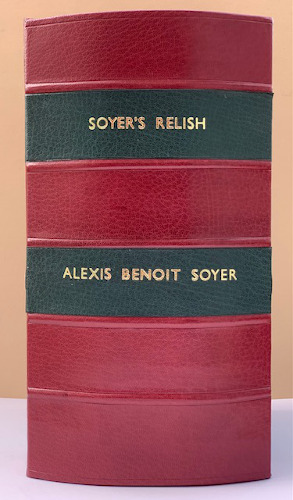
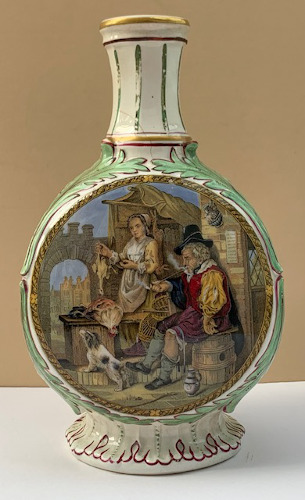
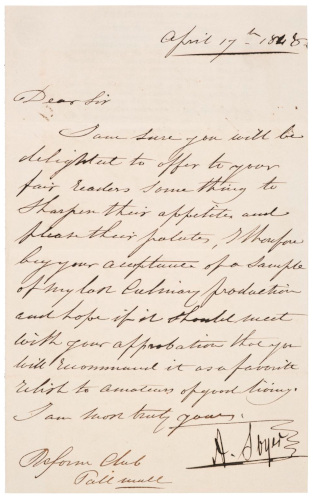
ITEM # 1 - n/d circa the 1850's. 195mm tall x 110mm wide. Decorated on three sides. Side 1: The famous portrait of Soyer in his trademark cocked beret, painted by his equally famous wife Emma Soyer [nee Jones]. There is an 6mm very slightly raised flake on the base under Soyer's portrait, but not detracting. Side 2: The Fish-market. Side 3: The Poultry-woman. There is a very fine 1.5" heat crack to the glace. on the lower part of the neck. Beautifully painted and decorated with raised ceramic piping in green, maroon and gold. A few gold lines on the neck are very slightly worn. ITEM # 2 - A one-page letter folded in half with the script on 1/4. 8vo. Signed by Soyer. It has presumably been written by a secretary in a lovely cursive script at the Reform Club Pall Mall, dated April 17th 1848. It starts; Dear Sir I am sure you will be delighted to offer your fair readers something to sharpen their appetites and please their palates, I therefore by your acceptance of a sample of my last culinary production and hope if it should meet with your approbation that you will recommend it as a favourite relish to amateurs of good living. I am most truly yours A. Soyer. It has then been folded again and addressed to the Lady's Newspaper. At some point it has been sealed for delivery. Now kept securely in a marbled cardboard folder. Both items housed for preservation in a very solid clam-shell box: 270 x 200 x 146mm. Quarter maroon morocco with tips. Spine with raised bands and two green morocco labels with gilt lettering. Green cloth sides. The interior with padded dark green felt cushioning. Everything in very good condition.
- - This bottle originally contained "Soyer's Sultana Sauce" and marketed by Messrs. Edmund Crosse and Thomas Blackwell as "Soyer's Relish", The whole design is definitely in keeping with the style of Soyer's 'a la zoug-zoug' predilection. (To understand what this means, see item #10991 on this site) and read George Augustus Sala's very interesting description of Alexis Soyer's eccentric design and style bias. Soyer manufactured his first piquant sauce; "The Lady and Gentleman's Sauce", in 1848, priced 2s 6d. He also marketed it himself [see image # 6 below]. The letter was addressed to the editor of the 'Lady's Newspaper'. Soyer was an inveterate self-promoter and obviously had a full quota of marketing skills as well. Due to his own efforts, the Relish was extremely popular and he intended to keep the recipe to himself but he was typically very busy with other pursuits. He agreed to a meeting with Crosse & Blackwell. Finding the terms offered for the recipe to be very advantageous, he sold it to them. Then in August 22nd, 1850 [ref: Lon. Metropolitan Archives #MA/4467/A01/003. Declaration of Goods Quality] he brought out "Soyer's Relish". From its inception, it was well patronized above and beyond expectations. Because of its great popularity, Crosse and Blackwell commissioned a limited amount of this very special bottle from F. & R. Pratt & Co. Whilst Felix Pratt was the commercial driving force behind the business, the artist was Jesse Austin who joined Pratt in the early-1840's. He was an accomplished water-colour artist and engraver and in nearly 40 years produced over 550 poly chrome prints used to decorate the now well-known small pot lids manufactured for many types of potted food-stuffs. Pratt’s first under-glaze, polychrome pot lid was made in 1847 and was a scene titled ‘Grace before Meals’. Austin’s subjects included royalty, famous people, city scenes. (The portrait of Soyer here is a copy of the famous image painted by his well-known artist wife, Emma Soyer nee; Jones, now hanging in the Nat. Portrait Gallery, London). This portrayal of the life and times of Victorian England is one of the reasons for the popularity of the pot lids today. Austin also made miniature water-colour copies of famous paintings that also appear on Prattware. Although the pot lids have become well known, the engravings were also used on the pots themselves, on plates and on other domestic earthenware manufactured by the business. It is this good-quality domestic pottery that is termed ‘Prattware’. So good were the engravings that the pot lids and Prattware rapidly became a collectible and the first exhibition was apparently held in 1897 only three years after Felix Pratt’s death. Cauldon Potteries Ltd acquired Pratt & Co in 1933 and continued to issue reproduction pot lids under the F. & R. Pratt name using the original Jesse Austin engravings and the practice was continued up to the 1960s by the various owners of the Pratt name. It is not known how many of these exotic and unusual tricorn 'Soyers' Relish' bottles were produced and sold, but one that came up for auction on July 2004, sold for four times the projected price. A very collectable object with the very rare signed letter pertaining to the bottle and it's past contents.

click on image to enlarge
Information

Ephemera category
ref number: 11296

Soyer.   Elizabeth Emma [nee Jones]     - Drawn by the artist when she was fifteen
An Original Drawing.
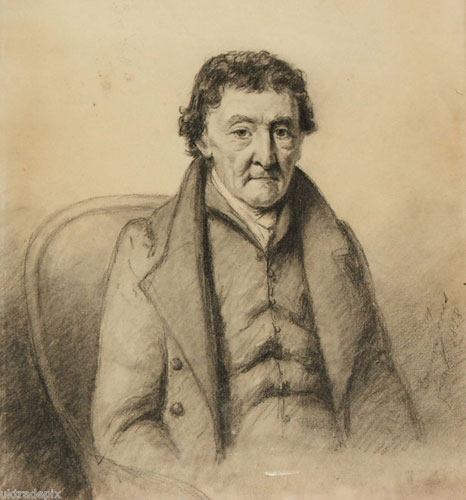
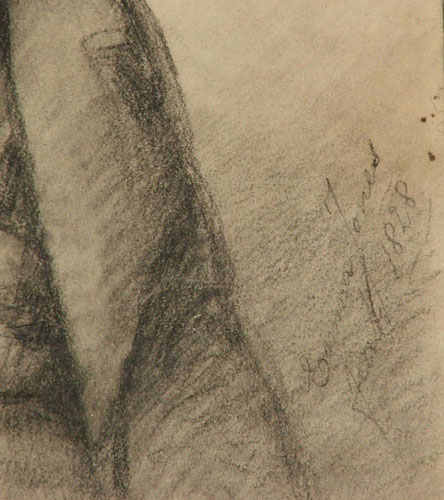
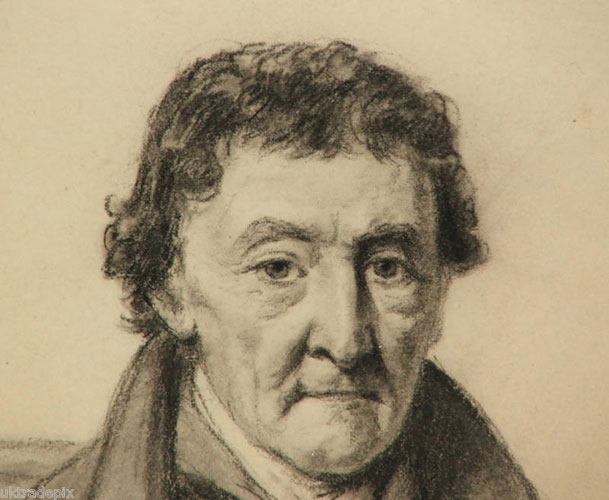
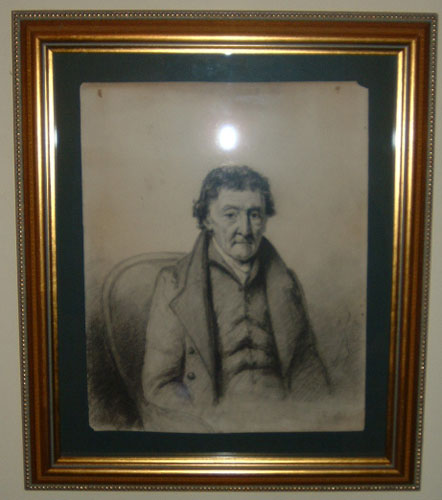
Exquisite black crayon period portrait of older man seated. Wearing a jacket with wide lapels, a waistcoat and a white neck-scarf. Identity of the sitter unknown. Signed by Emma Jones and dated 1828.
Actual Drawings - 7.5"x 9" = 190 x 228mm. Frame - 11.5 "x13" = 292 x 330mm. Sympathetically mounted on a dark green/grey cardboard backing with glass fronted, gold brushed frame. The edges of the paper slightly cracked but altogether nicely aged. Overall a very rare and handsome item.
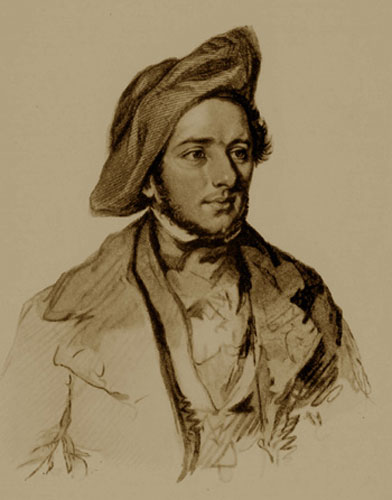
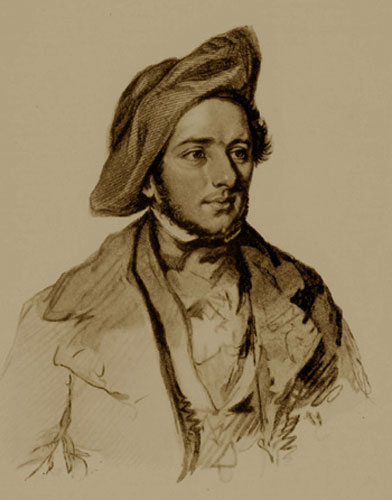
- Elizabeth Emma Jones was born in London - 1813. In 1836 she married Alexis Benoist Soyer the famous Chef de Cuisine of the Reform Club, Pall Mall, London. She died on the 29th of August, 1842, aged twenty-nine. Miss Emma Jones acquired the rudiments of her vocation under the guidance of Mons. Simonau, a Flemish artist, who subsequently became her step-father. She showed talent from a very young age and first exhibited at the Royal Academy in 1823, at barely ten years old. This highly accomplished artist focused on portraiture and studies of nature. Her works were popularised through engravings and she went on to exhibit at the Paris Salon from 1840-42. Her reputation in France stood higher than even her native country. She was regarded as unusual and precociously gifted. Her works were admired because they were said to have been marked by great vigour and breadth of light and shadow. This can be seen in the portrait on offer here. Astonishingly, it was completed when she was just fifteen years old and shows a great degree of artistic maturity. The famous portrait of her husband Alexis Soyer wearing his beret, (see below) is a stipple engraving by Henry Bryan Hall originally from a drawing by Emma. It is housed in the National Portrait Gallery. Notwithstanding Madame Soyer's death at such a young age she was a prolific artist who left behind upwards of 400 paintings, which received commendations of the highest character. Soyer's already bright reputation was considerably enhanced by his marriage to Emma. While he was in a meeting in Belguim with the king, Emma became very frightened during a severe thunderstorm and she had a miscarriage and died. Soyer was distraught and never forgave himself for his absence, not even when, in 1850, receiving a letter from Alexis Lemain claiming to be his son - the result of an early liaison in Paris - he accepted paternity. Emma and Soyer are both buried together at Kensal Green cemetery. As of August 2008, Emma and Soyer's impressive but weather-beaten monument has been granted public money for a complete renovation, to be started by the October of that same year. The plot holds four bodies. Besides Alexis and Emma there is Francois Simonau (1859) the artist, mentor and stepfather to Emma mentioned above. Then finally a Lady Watts (1929) who was Francois Simonau's grand niece. Emma (Soyer) Jones's paintings and drawings are very rare and seldom appear at auction or on the market.

click on image to enlarge
Information

Ephemera category
ref number: 11091

Soyer.   Elizabeth Emma [nee Jones]     - Drawn by the artist when she was fifteen
An Original Drawing.
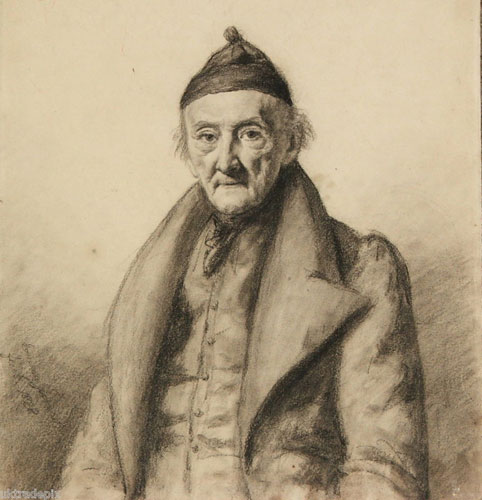
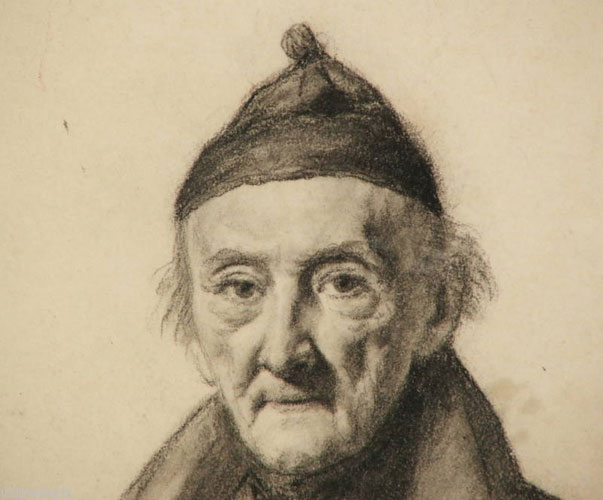
Exquisite black crayon period portrait of an old man seated. Wearing a peaked cap, high necked waistcoat, small knotted neckerchief and a jacket with wide lapels. Identity of the sitter unknown. Signed by Emma Jones and dated 1828.
Actual Drawings - 7.5"x 9" = 190 x 228mm. Frame - 11.5 "x13" = 292 x 330mm. Sympathetically mounted on a dark green/grey cardboard backing with glass fronted, gold brushed frame. The edges of the paper slightly cracked but altogether nicely aged. Overall a very rare and handsome item.
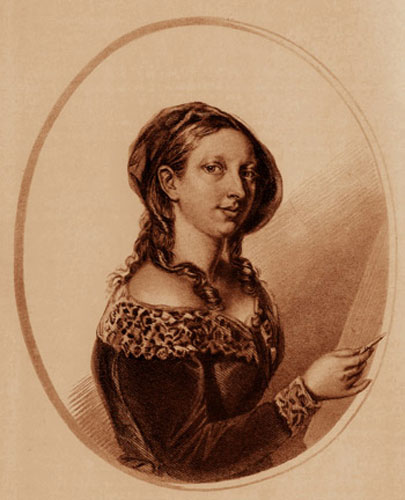
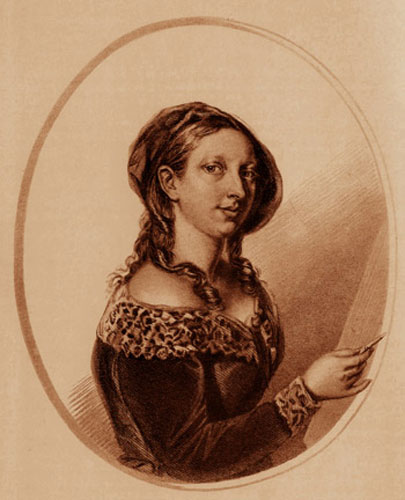
- Elizabeth Emma Jones was born in London - 1813. In 1836 she married Alexis Benoist Soyer the famous Chef de Cuisine of the Reform Club, Pall Mall, London. She died on the 29th of August, 1842, aged twenty-nine. She showed talent from a very young age and first exhibited at the Royal Academy in 1823, at barely ten years old. This highly accomplished artist focused on portraiture and studies of nature. Her works were popularised through engravings and she went on to exhibit at the Paris Salon from 1840-42. Her reputation in France stood higher than even her native country. She was regarded as unusual and precociously gifted. Her works were admired because they were said to have been marked by great vigour and breadth of light and shadow. This can be seen in the portrait on offer here. Astonishingly, it was completed when she was just fifteen years old and shows a great degree of artistic maturity. The famous portrait of her husband Alexis Soyer wearing his beret, (see below) is a stipple engraving by Henry Bryan Hall originally from a drawing by Emma. It is owned by the National Portrait Gallery. The first picture below is a self-portrait drawn by Emma.

click on image to enlarge
Information

Ephemera category
ref number: 11092